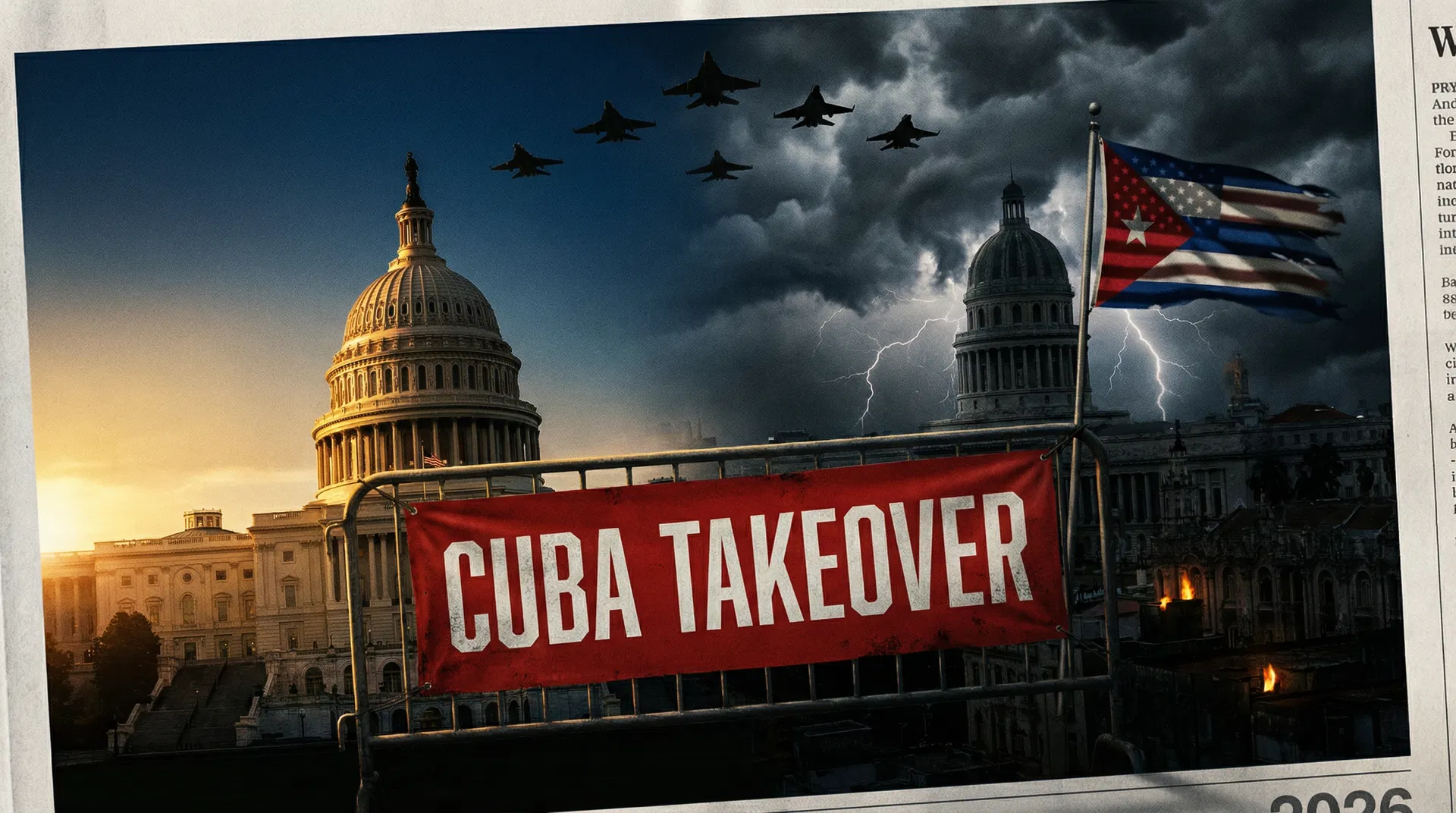
The Moment Has Arrived: Trump Says He'll "Have the Honour of Taking Cuba"
On March 16, 2026, as Cuba's national power grid collapsed into total darkness , leaving all 10 million residents without electricity , President Donald Trump stood before reporters at the White House and made a declaration that sent shockwaves through the Western Hemisphere.
"I do believe I'll be… having the honour of taking Cuba," Trump said. "Whether I free it, take it , think I could do anything I want with it. You want to know the truth. They're a very weakened nation right now."
This was not a casual remark. It was the culmination of a deliberate, months-long pressure campaign that has systematically dismantled Cuba's economy, severed its energy supply, and positioned the United States for what analysts increasingly describe as an inevitable political intervention. At The Odds Post, we are assigning an 85% probability that the United States will execute a formal takeover, regime change, or forced political transition in Cuba no later than April 30, 2026.
Here is why we believe this outcome is nearly certain , and why national security is the engine driving it.
The National Security Case: Cuba Is a Threat in America's Backyard
The foundation for any US action against Cuba was laid on January 29, 2026, when President Trump signed an executive order declaring Cuba "an unusual and extraordinary threat" to the national security and foreign policy of the United States. This was not rhetorical posturing , it was a legal declaration that activated emergency economic powers and set the stage for escalating intervention.
The White House executive order cited a damning list of national security concerns that go far beyond Cuba's communist ideology:
Russia's Intelligence Foothold: Cuba hosts Russia's largest overseas signals intelligence facility, which the Trump administration says is actively used to intercept and steal sensitive US national security information. This is not a Cold War relic , it is an active threat operating 90 miles from Florida.
China's Military Cooperation: Cuba has been deepening intelligence and defense cooperation with the People's Republic of China, creating a dual adversary intelligence platform in America's immediate neighborhood.
Terrorist Safe Harbor: According to the executive order, Cuba has welcomed Hezbollah and Hamas, providing these transnational terrorist organizations with a base to build economic, cultural, and security ties throughout the Western Hemisphere.
Venezuela and Iran Alignment: Cuba's deep integration with Venezuela's Maduro regime and Iran's government creates a hostile axis of influence that the Trump administration views as an existential threat to regional stability.
These are not abstract concerns. They represent a concrete intelligence and military threat operating in the Caribbean , and the Trump administration has made clear it will not tolerate them.
The Pressure Campaign: Engineered Collapse
What makes our 85% prediction so confident is not just Trump's rhetoric , it is the systematic, engineered nature of Cuba's current collapse. The United States has not simply imposed sanctions; it has constructed a comprehensive pressure campaign designed to bring the Cuban government to its knees.
In January 2026, Trump warned of tariffs on any country that sells or provides oil to Cuba. The effect was immediate and devastating. No oil has been imported to Cuba since January 9, 2026. The island nation of 10 million people has received only two small vessels carrying oil imports this entire year. The result has been catastrophic: Cuba has experienced three major nationwide blackouts in four months, including the complete collapse of the national power grid on March 16, 2026.
The humanitarian consequences are severe. Food spoils before it can be consumed. Hospitals struggle to maintain power. Families are unable to refrigerate medicine. The Cuban people , already suffering from years of economic misery , are now facing a crisis that the government cannot manage, cannot explain away, and cannot survive politically.
This is not an accident. It is a strategy. And it is working.
The Political Endgame: Regime Change Is the Stated Goal
Unlike previous US administrations that maintained ambiguity about their Cuba objectives, the Trump administration has been remarkably direct. Senior officials have openly stated that Washington is seeking regime change in Communist-led Cuba. The administration is looking for Cuban President Miguel Díaz-Canel to leave power as Washington continues to negotiate with the Cuban government about the island's future.
Díaz-Canel himself confirmed last week , for the first time , that his government has held talks with the Trump administration. This is a significant admission. It signals that the Cuban government recognizes its vulnerability and is exploring options for a negotiated transition. The Cuban government has simultaneously extended an invitation to Cuban Americans and exiles abroad to invest in and own businesses on the island , a dramatic reversal of communist economic policy that suggests Havana is preparing for a post-communist future.
Trump has previously suggested a "friendly takeover" of Cuba, and on March 16 he said Cuba "wants to make a deal." The contours of that deal are becoming visible: a political transition away from communist rule, in exchange for relief from the oil blockade and economic pressure.
The Timeline: Why April 30 Is the Critical Deadline
Our April 30, 2026 deadline is not arbitrary. It is based on a convergence of factors that make the current trajectory unsustainable beyond that point:
Energy Infrastructure Collapse: Cuba's power grid has now failed three times in four months. Each failure is more severe than the last. Without oil imports, the grid cannot be stabilized. By late April, the cumulative damage to generators and transmission infrastructure will make recovery increasingly difficult even if oil were restored.
Social Unrest Threshold: The March 2026 blackout has already triggered rare public protests, including the torching of a Communist Party office. As conditions worsen through April, the social pressure on the Díaz-Canel government will become overwhelming. Historical precedent suggests that governments facing simultaneous economic collapse, energy failure, and public unrest rarely survive beyond 60–90 days.
US Negotiating Leverage: The Trump administration currently holds maximum leverage. Cuba is weakened, isolated, and desperate. Every week that passes without a deal further erodes Cuba's negotiating position. The administration has every incentive to close a deal before April 30 while its leverage is at its peak.
Senate Democratic Opposition: Senate Democrats have introduced measures to prevent military action against Cuba, following similar measures on Venezuela and Iran. This congressional opposition creates a political incentive for the Trump administration to move quickly , before legislative constraints can be strengthened.
What "Takeover" Actually Means: Three Scenarios
When we assign 85% probability to a "Trump Cuba takeover," we are not predicting a military invasion. The most likely scenarios are more nuanced:
Scenario 1 , Negotiated Political Transition (Most Likely, 55%): Díaz-Canel agrees to step down or transfer power to a transitional government acceptable to Washington, in exchange for relief from the oil blockade and economic sanctions. Cuban Americans are invited to invest and lead reconstruction. The US frames this as "liberation" rather than conquest.
Scenario 2 , Forced Regime Collapse (25%): The combination of blackouts, food shortages, and public unrest triggers a popular uprising that overwhelms the Cuban security apparatus. The government collapses without direct US military action, but with US support for opposition forces. Washington steps in to manage the transition.
Scenario 3 , Direct US Intervention (5%): If negotiations fail and the Cuban government refuses to transition, the Trump administration uses its IEEPA emergency powers and the national security declaration to authorize direct action. This is the least likely scenario but cannot be excluded given Trump's rhetoric.
Scenario 4 , Status Quo Continues (15%): Cuba somehow stabilizes, finds alternative oil sources (China or Russia), and the Díaz-Canel government survives beyond April 30. This is our 15% "no" probability.
The Geopolitical Stakes: Why This Matters Beyond Cuba
A US takeover of Cuba would be the most significant geopolitical event in the Western Hemisphere since the Cuban Missile Crisis of 1962. The implications extend far beyond the island:
It would eliminate Russia's largest overseas signals intelligence facility, delivering a major blow to Russian intelligence capabilities targeting the United States. It would sever China's deepening military and intelligence cooperation with a Caribbean nation 90 miles from Florida. It would remove a key node in the Venezuela-Cuba-Iran axis that the Trump administration views as a regional threat network. And it would send an unmistakable message to every government in the Western Hemisphere about the consequences of hosting US adversaries.
This is why the Trump administration is willing to impose severe humanitarian costs on the Cuban people to achieve this objective. The national security calculus, from Washington's perspective, is straightforward: the long-term threat of a Russian-Chinese-Iranian intelligence platform in the Caribbean outweighs the short-term humanitarian costs of the pressure campaign.
Frequently Asked Questions
Q: Is Trump actually planning a military invasion of Cuba?
A: Direct military invasion is the least likely scenario (approximately 5% probability). The more probable outcomes are a negotiated political transition or a government collapse driven by economic pressure and public unrest. Trump has spoken of a "friendly takeover" and has indicated Cuba "wants to make a deal," suggesting a negotiated outcome is preferred.
Q: Why is Cuba's power grid collapsing now?
A: Cuba's aging electrical infrastructure has been deteriorating for years, but the US oil blockade , which has prevented any significant oil imports since January 9, 2026 , has removed the fuel needed to power generators. The result has been three major nationwide blackouts in four months, including a complete grid collapse on March 16, 2026.
Q: What does the Trump executive order on Cuba actually say?
A: Signed January 29, 2026, the executive order declares Cuba "an unusual and extraordinary threat" to US national security, citing Cuba's hosting of Russian intelligence facilities, military cooperation with China, and provision of safe harbor to terrorist organizations including Hezbollah and Hamas. It declares a national emergency and activates emergency economic powers.
Q: What happens to Cuban Americans if there is a takeover?
A: The Cuban government has already extended an invitation to Cuban Americans and exiles abroad to invest in and own businesses on the island. A US-backed transition would likely accelerate this process, potentially creating significant economic opportunities for the Cuban diaspora in the United States.
Q: Could China or Russia intervene to save the Cuban government?
A: This is the primary risk factor in our analysis. Russia and China both have strategic interests in maintaining a foothold in Cuba. However, both countries are currently constrained , Russia by its war in Ukraine, China by its trade tensions with the United States. Neither appears willing to risk direct confrontation with the US over Cuba at this moment.
Q: How does this relate to Trump's Venezuela policy?
A: Cuba and Venezuela are deeply interconnected. Cuba provides security and intelligence services to the Maduro regime in Venezuela, while Venezuela provides oil to Cuba. The US pressure campaign on both countries simultaneously is designed to collapse this mutual support network. Senate Democrats have introduced measures to prevent military action against both Cuba and Venezuela, suggesting the administration is pursuing parallel tracks.
Our Prediction: 85% Confidence, April 30 Deadline
The evidence is overwhelming. The Trump administration has declared a national emergency over Cuba, imposed a comprehensive oil blockade, stated openly that it seeks regime change, and the President himself has said he will "have the honour of taking Cuba." The Cuban government is in active negotiations with Washington, its economy is collapsing, its power grid has failed three times in four months, and its people are taking to the streets.
We assign 85% probability that the United States will execute a formal takeover, regime change, or forced political transition in Cuba no later than April 30, 2026. The remaining 15% accounts for the possibility that Cuba finds alternative energy sources, that China or Russia intervene more aggressively than expected, or that a negotiated deal takes longer than anticipated.
This is the most consequential geopolitical prediction we have made at The Odds Post. We invite you to vote, share your analysis, and join the community discussion. History is being made 90 miles from Florida , and we are watching it unfold in real time.
Cast your vote and join the discussion at The Odds Post.
Related: Cuba Emergency Oil Deal Prediction | Venezuela Oil Crisis