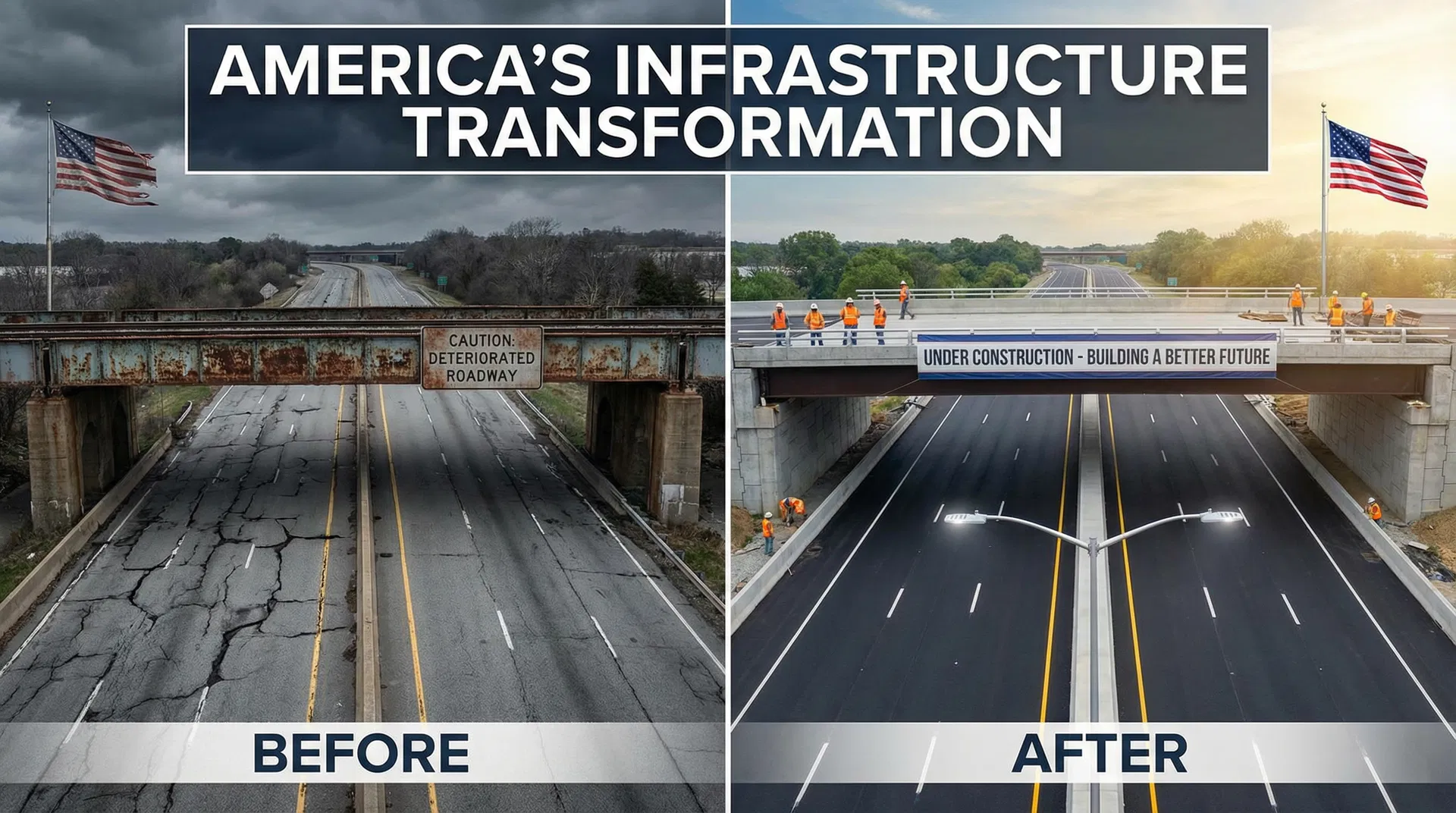
The Supreme Court's February 20, 2026 decision striking down President Trump's tariffs created an immediate political firestorm over $134 billion in collected revenue. Politicians are debating whether to return this money as $450 stimulus checks to individual Americans or apply it toward the national debt. Both options miss a far more strategic opportunity: investing these funds in America's crumbling transportation infrastructure to rebuild the foundation of our economy from coast to coast.
This is not about choosing between helping Americans or being fiscally responsible. Infrastructure investment accomplishes both goals simultaneously while creating a lasting legacy that serves every citizen, every business, and every community for decades to come. The question is whether we have the political will to choose long-term prosperity over short-term gratification.
The Infrastructure Crisis Hiding in Plain Sight
America's transportation infrastructure is failing, and the consequences are devastating. The American Society of Civil Engineers' 2025 Infrastructure Report Card gave our overall infrastructure a grade of C, a marginal improvement from C- four years ago, but still representing a system in mediocre condition with significant deficiencies. The report identifies a staggering $3.7 trillion investment gap over the next decade just to bring infrastructure systems into a state of good repair.
The numbers tell a sobering story. Despite spending $1.5 trillion on surface transportation since 1991, only 47 percent of federal-aid highways have "good" ride quality, while nearly 23 percent have "poor" ride quality, a condition that has actually worsened over time. For bridges, the situation is equally troubling: only 46 percent are in good repair, with thousands of structures carrying traffic loads far beyond their original design specifications.
These statistics translate into real costs for American families and businesses. Crumbling roads and bridges cost New York motorists alone $38 billion annually through vehicle damage, increased fuel consumption, and lost time. Multiply that across all fifty states, and the economic drain becomes astronomical. The Texas A&M Transportation Institute estimates that traffic congestion costs the American economy over $160 billion per year in lost productivity, congestion that infrastructure improvements could significantly reduce.
Perhaps most alarming is the safety crisis. The United States has the most dangerous roads in the developed world. American roads are twice as deadly as Greece, three times as deadly as Israel, and six times as deadly as Norway. Pedestrian fatalities have surged 75 percent since 2010, even as other developed nations reduced pedestrian deaths by 29 percent. Our infrastructure is literally killing Americans at rates that would be considered unacceptable in any other wealthy nation.
Why Previous Infrastructure Spending Failed
Before advocating for new infrastructure investment, we must confront an uncomfortable truth: previous federal transportation spending has largely failed to achieve its stated goals. The $1.5 trillion spent since 1991 did not improve safety, reduce congestion, or even maintain existing roads and bridges in good condition. Understanding why this happened is essential to ensuring that $134 billion in tariff revenue produces different results.
The fundamental problem has been misaligned priorities. Federal transportation policy has prioritized highway expansion over maintenance, vehicle throughput over safety, and short-term political wins over long-term sustainability. State departments of transportation received massive federal funding with minimal accountability for outcomes, leading to a predictable pattern: build new highways to generate ribbon-cutting ceremonies while deferring maintenance on existing infrastructure until systems fail catastrophically.
The results speak for themselves. Between 1993 and 2017, the one hundred most populous U.S. cities added 30,511 new freeway lane-miles, a 42 percent increase that significantly outpaced the 32 percent population growth in those regions. Yet congestion increased 144 percent during the same period. Every single one of these metro areas experienced worse congestion despite massive highway expansion. In Brownsville, Texas, population increased 73 percent, freeway lane-miles increased 287 percent, and congestion still increased 1,230 percent. Even Detroit, which lost five percent of its population, saw congestion increase 45 percent despite adding 15 percent more freeway capacity.
This pattern reveals a fundamental misunderstanding of how transportation systems work. Building more highway capacity induces additional driving through a phenomenon economists call "induced demand." New roads fill up with traffic almost immediately, requiring even more expansion in an endless cycle that never achieves the promised congestion relief. Meanwhile, deferred maintenance on existing infrastructure creates a growing backlog of repairs that becomes exponentially more expensive over time. Repairing a road that has fallen into poor condition costs up to fourteen times as much as preserving a road in good condition to begin with.
The environmental consequences have been equally disastrous. Current federal transportation spending patterns are projected to increase emissions by 190 million metric tonnes through 2040, the equivalent of five hundred natural gas-fired power plants or fifty coal-fired power plants running for a year. At a time when climate change threatens coastal cities, agricultural productivity, and national security, federal transportation policy is actively making the problem worse.
A Different Approach: Maintenance-First Infrastructure Investment
The $134 billion in tariff revenue represents an opportunity to break this destructive cycle and implement a fundamentally different approach to infrastructure investment. Instead of building new highways that induce more driving and generate more maintenance obligations, these funds should prioritize bringing existing infrastructure into a state of good repair while modernizing systems to meet twenty-first-century needs.
A maintenance-first strategy delivers far greater return on investment than expansion projects. Preventive maintenance on roads in good condition costs a fraction of reconstructing roads that have deteriorated to poor condition. The same principle applies to bridges, where regular inspection and targeted repairs prevent catastrophic failures that require complete replacement. By focusing on preservation rather than expansion, $134 billion can accomplish far more than the same amount spent on new construction.
This approach also aligns with fiscal responsibility. Maintaining existing infrastructure protects the massive public investment already made in transportation systems. Allowing roads and bridges to deteriorate while building new ones is equivalent to buying a new car every few years while never changing the oil in your existing vehicles. It is wasteful, shortsighted, and ultimately more expensive than proper maintenance.
Beyond basic maintenance, strategic infrastructure investment can modernize transportation systems to address contemporary challenges. This includes upgrading traffic management systems with smart technology that reduces congestion through better signal timing and real-time routing. It means strengthening bridges and roads to withstand more frequent extreme weather events driven by climate change. It involves improving freight corridors to reduce supply chain bottlenecks that drive up costs for consumers. And it requires expanding public transit options that give Americans alternatives to sitting in traffic while reducing emissions and improving air quality.
The economic multiplier effects of infrastructure investment are well-documented. Every dollar spent on transportation infrastructure generates approximately $1.70 in economic activity through direct construction jobs, indirect supplier jobs, and induced spending by workers. Infrastructure improvements reduce vehicle operating costs, decrease shipping times for businesses, and improve access to employment opportunities for workers. These benefits compound over time, creating sustained economic growth that far exceeds the initial investment.
Making America Great Again Through Infrastructure
The phrase "Make America Great Again" resonates because it taps into a genuine desire to restore American competitiveness and prosperity. But greatness is not built on nostalgia or rhetoric, it is built on the physical foundation of roads, bridges, ports, and transit systems that enable economic activity. America became great in the twentieth century partly because we invested in world-class infrastructure that gave businesses and workers advantages over global competitors. We are losing that advantage as our infrastructure crumbles while other nations modernize their systems.
China has invested trillions in high-speed rail, modern ports, and advanced logistics networks that make their economy more efficient and competitive. European nations maintain infrastructure systems that Americans envy when they visit. Even developing nations are building transportation infrastructure superior to what exists in many American cities. If we want to restore American greatness, we must rebuild the physical foundation that enables prosperity.
The $134 billion in tariff revenue will not solve the entire $3.7 trillion infrastructure funding gap, but it represents a meaningful down payment that can catalyze additional investment. Federal infrastructure spending often leverages state and local matching funds, private sector investment, and financing mechanisms that multiply the impact of initial appropriations. Strategic deployment of $134 billion could unlock hundreds of billions in additional infrastructure investment over the next decade.
More importantly, dedicating tariff revenue to infrastructure sends a powerful signal about national priorities. It demonstrates that America is serious about long-term competitiveness rather than short-term political expediency. It shows that we are willing to make investments that benefit all Americans, not just those who receive stimulus checks, and that serve future generations rather than just current voters. It proves that we can think strategically about national challenges instead of lurching from crisis to crisis with Band-Aid solutions.
The Political Case for Infrastructure Investment
Politicians often assume that voters prefer immediate cash payments over long-term investments, but this underestimates the American people. Polling consistently shows strong bipartisan support for infrastructure investment. Americans understand that crumbling roads and bridges affect their daily lives through vehicle damage, traffic delays, and safety risks. They recognize that infrastructure creates jobs in their communities while building assets that serve everyone.
The political appeal of infrastructure investment extends across ideological divides. Fiscal conservatives appreciate that maintenance prevents more expensive reconstruction later while protecting existing public investments. Economic populists support the well-paying construction jobs that infrastructure projects create in communities across the country. Environmentalists favor investments that reduce emissions and build climate resilience. Business leaders want improved freight corridors and reduced congestion that lower operating costs. Suburban commuters, urban residents, and rural communities all depend on functional transportation infrastructure.
Contrast this broad coalition with the political dynamics of stimulus checks. While $450 per person sounds appealing, it is not enough money to meaningfully change anyone's financial situation. It will be spent and forgotten within weeks, leaving no lasting benefit and creating no political legacy. Worse, the logistics of distributing stimulus checks are complex and contentious, with inevitable disputes over eligibility, income thresholds, and distribution mechanisms that create political losers for every winner.
Infrastructure investment avoids these pitfalls. Every state, every congressional district, and every community has infrastructure needs that $134 billion can help address. Projects can be distributed geographically to ensure broad benefits while prioritizing the most critical repairs based on engineering assessments rather than political favoritism. The results are visible and lasting: repaved roads, reinforced bridges, modernized transit systems that voters can see and use every day.
Overcoming the Refund Obstacle
The strongest argument against using tariff revenue for infrastructure is that businesses and consumers who paid the tariffs deserve refunds. This concern has legal and moral weight. Thousands of companies have already filed lawsuits seeking to recover tariff payments, and the Supreme Court's ruling that the tariffs lacked legal authority strengthens their claims.
However, the refund process will be extraordinarily complex, expensive, and incomplete regardless of how it proceeds. Many businesses that paid tariffs have since closed or lack the resources to navigate the claims process. Administrative costs of processing refunds will consume billions of dollars. Disputes over eligibility and amounts will tie up courts for years. Ultimately, perhaps $120 to $140 billion of the $175 billion collected will be returned to businesses, with the remainder absorbed by administrative costs and disputed claims.
Rather than allowing this money to disappear into a bureaucratic morass, Congress could establish a compromise that serves both justice and national interest. Businesses with documented tariff payments could receive partial refunds or tax credits, while the remaining funds are dedicated to infrastructure investment that benefits those same businesses through reduced transportation costs and improved logistics networks. This approach acknowledges the unfairness of the tariffs while channeling the revenue toward productive use rather than administrative waste.
The alternative, returning all tariff revenue to businesses while continuing to defer infrastructure maintenance, guarantees that we will face an even larger infrastructure crisis in the future. The $3.7 trillion funding gap will grow to $5 trillion or more as deferred maintenance compounds. Eventually, catastrophic failures will force emergency spending at far higher costs than preventive investment would have required. We can pay now for planned improvements, or pay much more later for emergency repairs. The choice is obvious to anyone thinking beyond the next election cycle.
A Call to Action: Choose the Foundation
The debate over $134 billion in tariff revenue is ultimately a referendum on American priorities. Do we want short-term political wins or long-term prosperity? Do we want to paper over problems with stimulus checks that will be spent and forgotten, or invest in infrastructure that serves generations? Do we want to continue the failed policies of the past thirty years, or chart a new course that rebuilds America's competitive foundation?
The answer should be clear to anyone who genuinely wants to make America great again. Greatness is not built on stimulus checks or political slogans. It is built on the unglamorous but essential foundation of roads, bridges, and transit systems that enable economic activity and improve quality of life for all Americans. It is built by leaders who have the courage to choose long-term investment over short-term gratification.
We all use transportation infrastructure every single day. Every commute to work, every delivery to our homes, every product in stores, and every service we consume depends on functional roads and bridges. Infrastructure is not a special interest, it is the foundation of modern life. Investing $134 billion in that foundation is not a favor to construction companies or transportation agencies. It is an investment in ourselves, our communities, and our shared future.
The Supreme Court's tariff ruling has handed us an unexpected opportunity. We can squander it on stimulus checks that provide fleeting satisfaction, or we can seize it to rebuild the infrastructure foundation that will serve America for decades. The choice we make will reveal whether we are serious about national renewal or merely engaged in political theater.
Let us choose wisely. Let us choose the foundation.
What do you think should happen to the $134 billion in tariff revenue? Join the discussion on The Odds Post, where you can vote on predictions, share your perspective, and see what the community thinks about this critical decision. Your voice matters in shaping America's future, make your prediction count.